

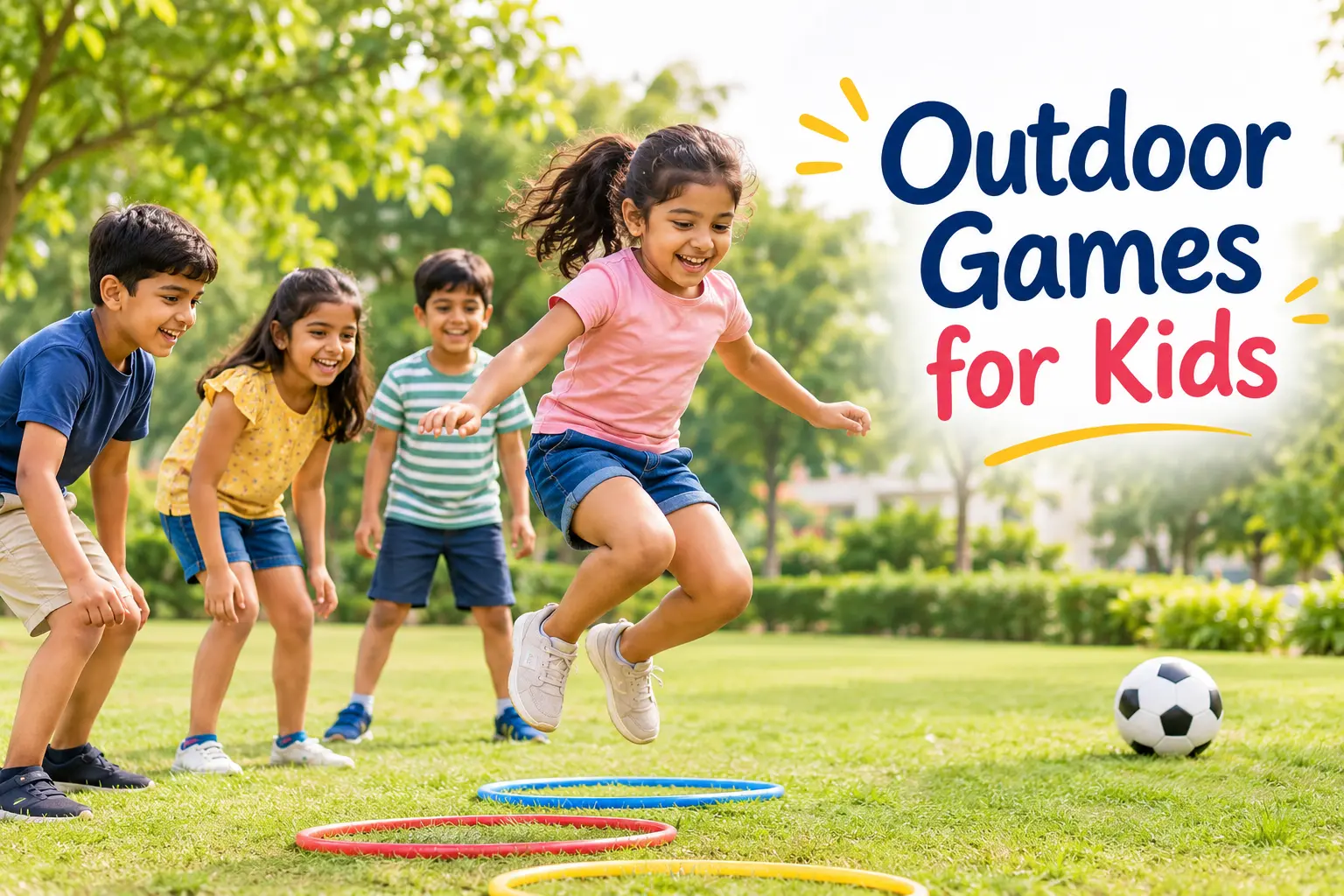
Children today spend a lot of time indoors, whether they are attending online classes, watching videos, playing mobile games or completing homework. While these activities have their place, children also need time to step outside, move around and play. Outdoor games give them a fun way to stay active without making exercise feel like a task.
From classic games like hide and seek and tag to sports like football and badminton, there are plenty of ways to get children moving. The best part is that many outdoor games do not require expensive equipment or even a large playground. A little space, a few friends and some imagination are often enough.
In this blog, let's explore 15 outdoor games for kids, their benefits, and how parents and schools can make outdoor play a regular part of children's lives.
Why outdoor games are important for children
Playing outdoors is about much more than keeping children occupied. It gives them opportunities to develop physical strength, interact with others, solve problems and become more confident.
Unlike activities that involve sitting for long periods, outdoor games encourage children to move, explore and respond to their surroundings. They also learn important everyday skills while having fun.
Physical benefits of outdoor games
Regular outdoor play helps children develop healthy habits from an early age. Running, jumping, stretching and throwing involve different muscle groups and help improve overall fitness.
Here are some important physical benefits of outdoor games:
- Improves physical fitness
- Develops coordination
- Builds balance and flexibility
- Supports healthy growth
- Improves stamina
Outdoor play also gives children an opportunity to enjoy fresh air and spend less time sitting in front of screens.
Social and emotional benefits
Outdoor games also help children develop skills that are important outside the playground.
When children play with friends, they learn how to communicate, cooperate and handle different situations. They also experience winning, losing and trying again.
Some of the key benefits include:
- Teamwork
- Communication
- Confidence
- Emotional control
- Problem-solving
These experiences help children become more independent and comfortable interacting with people around them.
15 fun outdoor games for kids
Not every outdoor game needs a playground, sports equipment or complicated rules. Some of the most enjoyable games can be played in a backyard, garden, school ground or any safe open space.
Here are 15 outdoor games for children that are easy to organise and enjoyable for different age groups.
Outdoor games without equipment
These games are perfect when children want to play but do not have access to toys or sports equipment. Most of them require only a little space and a group of players.
1. Hide and seek
Hide and seek is a classic game that children of different ages can enjoy. One child closes their eyes and counts while the others find places to hide. Once the counting is over, the seeker tries to find everyone.
The game encourages children to observe their surroundings, think creatively and make quick decisions. It also gets them moving as they search for hiding spots or try to avoid being found.
2. Tag
Tag is one of the easiest outdoor games to organise. One child is chosen as the tagger and tries to touch another player's shoulder or hand. Once tagged, that player becomes the new tagger.
Children can run, change directions and move around while trying not to get caught. It is a simple way to improve speed, agility and stamina.
3. Follow the leader
In this game, one child becomes the leader while everyone else follows their movements. The leader can jump, hop, walk backwards, clap or make funny movements.
The other children have to copy each action. After a few rounds, another child gets a chance to become the leader.
This game encourages listening, observation, coordination and creativity.
4. Simon says
Simon Says is a fun game that tests how carefully children listen. One player acts as Simon and gives instructions such as "Simon says touch your toes" or "Simon says jump three times."
Children should follow an instruction only when it begins with "Simon says". Anyone who follows an instruction without those words is out for that round.
The game helps improve listening skills, attention and the ability to follow directions.
5. Red light, green light
Choose one child to act as the traffic signal while the other players stand at a starting line.
When the leader says "Green light", everyone moves towards the finish line. When they say "Red light", everyone must stop immediately. Anyone caught moving has to return to the starting line or take a step back.
This game helps children practise self-control, balance and quick reactions.
Outdoor group games for kids
Group games are a great way to bring children together. They encourage teamwork, friendly competition and communication while keeping everyone physically active.
6. Dodgeball
Divide children into two teams and give them a few soft balls. The objective is to throw the balls towards players on the opposite team while avoiding being hit.
For younger children, use lightweight foam balls, keep the throwing distance short and establish simple rules. Avoid aiming at the face or head.
Dodgeball helps children practise coordination, movement and teamwork. It is important to keep the game friendly and ensure that everyone gets a chance to participate.
7. Relay race
A relay race is a simple team game that can be played in a school playground or an open area.
Divide children into teams and ask them to stand in separate lines. The first player runs to a marked point, returns and passes a baton or another object to the next player. The team that completes the race first wins.
You can make the game more interesting by adding activities such as hopping, skipping or balancing an object while walking.
Relay races help develop speed, stamina and team coordination.
8. Musical statues
Play some music while children dance, jump or move around in a designated area. When the music stops, everyone must freeze like a statue.
Anyone who moves after the music stops can sit out for that round. Continue until one player remains.
This is a fun activity for younger children because it combines movement with listening and self-control. It also works well during school events and outdoor celebrations.
9. Tug of war
Tug of war is a team game that requires a strong rope and a little open space.
Divide children into two equal teams and ask each team to hold one end of the rope. Mark a centre line on the ground. Both teams pull the rope towards their side, trying to bring the other team across the marked line.
Use a suitable rope, ensure children have enough space and supervise the game. Avoid wrapping the rope around anyone's hands or body.
Tug of war encourages teamwork, cooperation and physical strength.
10. Treasure hunt
A treasure hunt turns an ordinary outdoor space into an exciting adventure.
Hide small objects or clues around a safe play area. Give children hints that help them find each item. You can organise the activity individually or divide children into teams.
For younger children, use picture clues or simple directions. Older children can solve riddles or complete small challenges before finding the next clue.
Treasure hunts encourage observation, logical thinking, teamwork and problem-solving.
Outdoor sports and physical activities
If children enjoy sports, introduce them to activities that help develop specific physical skills. These games can also encourage them to discover interests that they may continue as they grow older.
11. Badminton
Badminton is a fun outdoor sport that children can play in pairs or small groups. Players use rackets to hit a shuttlecock over a net, trying to make it land within the opponent's court.
Children can start with simple rallies before learning more advanced techniques.
Badminton improves hand-eye coordination, balance, agility and concentration. It also teaches children how to follow rules and play fairly.
12. Football
Football is a popular team sport that children can enjoy in a playground or open field. The objective is to pass the ball between teammates and score goals by getting it into the opposing team's goal.
Younger children can begin with simple activities such as passing, dribbling and shooting. As they become more comfortable, they can participate in small team matches.
Football helps improve stamina, coordination, speed and teamwork.
13. Basketball
Basketball involves moving the ball across a court and scoring points by throwing it into the opponent's basket.
Children can start by practising basic skills such as dribbling, passing and shooting. For younger players, a smaller ball and a lower basket can make the game easier.
Basketball helps develop balance, coordination, agility and quick decision-making.
14. Hopscotch
Hopscotch is a traditional game that requires only a piece of chalk and a small open space.
Draw numbered boxes on the ground. Players throw a small marker into one of the boxes and hop through the numbered spaces, skipping the box containing the marker. They then turn around, return and collect the marker.
The game can be made more challenging by increasing the number of boxes or changing the hopping pattern.
Hopscotch helps children improve balance, coordination and number recognition.
15. Skipping rope
Skipping is an easy physical activity that children can enjoy individually or in groups.
All they need is a skipping rope and enough space to move safely. Children can begin with a few jumps and gradually increase the number as they become more comfortable.
You can also introduce group skipping games where two children turn a long rope while others take turns jumping through it.
Skipping helps improve cardiovascular fitness, coordination, rhythm and stamina.
How to choose the right outdoor games based on age
Children have different physical abilities, interests and attention spans as they grow. Choosing age-appropriate outdoor games helps them participate comfortably, develop new skills and enjoy playing.
| Age group | Suitable outdoor games | Skills developed |
|---|---|---|
| 3–5 years | Follow the leader, Simon Says, Musical Statues, Simple Treasure Hunts, Short Relay Races | Basic coordination, listening, balance and movement |
| 6–9 years | Hide and Seek, Tag, Red Light Green Light, Hopscotch, Relay Races, Badminton, Football | Teamwork, coordination, agility and following rules |
| 10–14 years | Basketball, Football, Badminton, Dodgeball, Tug of War, Skipping Challenges, Treasure Hunts | Leadership, stamina, strategy, teamwork and problem-solving |
Note: Remember that every child develops differently. Consider their interests, confidence and physical comfort when choosing outdoor activities. Encourage them to try different games without putting pressure on them to win.
How parents can encourage children to play outdoors
Children may not always choose outdoor play on their own, especially when they have access to television, video games and mobile devices.
Instead of simply asking them to put their screens away, parents can make outdoor activities something children look forward to. Here are a few practical ways to encourage them:
- Set aside time for outdoor play: Create a regular time during the day when children can step outside and play.
- Join them in their games: Play tag, badminton or hide and seek with your children. Your involvement can make the experience more enjoyable.
- Invite their friends: Children often enjoy playing more when they have friends or siblings around.
- Introduce different activities: Let children try different games instead of expecting them to enjoy the same sport every day.
- Avoid making play competitive: Focus on participation, enjoyment and learning rather than winning.
- Limit recreational screen time: Create a healthy balance between screen-based activities and physical play.
- Appreciate their efforts: Encourage children when they learn a new game, improve their skills or try something different.
Tips to make outdoor activities more interesting
If children are losing interest in regular games, try introducing small changes to make outdoor play exciting again.
- Create mini challenges: Ask children to complete a certain number of jumps, run a short distance or score a few goals. Keep the challenges achievable.
- Let children make the rules: Allow them to suggest new rules or create their own versions of familiar games. This gives them a sense of ownership.
- Organise weekend game sessions: Set aside some time on weekends for family games or activities with neighbourhood children.
- Explore different outdoor spaces: Visit a nearby park, playground or open ground to give children a change of environment.
- Use everyday objects creatively: Plastic cones, chalk, soft balls and empty cardboard boxes can be used to create simple outdoor games.
Parents can also encourage children to develop positive habits such as setting goals, staying motivated and trying new things. These habits are useful in academics and everyday life too.
How schools encourage physical activities and sports
Children spend a significant part of their day at school. This makes schools an important environment for introducing regular physical activities and helping students develop an interest in sports.
Schools can encourage outdoor play through dedicated physical education periods, playground activities, sports competitions and inter-house events.
They can also introduce different sports so that students with varying interests and abilities get opportunities to participate.
For instance, schools such as Scholars World School, Uppal, can make physical education and sports an important part of students' overall learning experience by encouraging participation in age-appropriate physical activities.
Importance of sports in school education
Sports and physical education contribute to several aspects of a child's development. They help students build healthy habits while learning skills that are useful in their personal and academic lives.
Here are some reasons why sports are important in school education:
- Develops discipline: Following practice schedules, understanding rules and working towards goals teach students discipline.
- Encourages teamwork: Team sports help students communicate, cooperate and support one another.
- Builds leadership skills: Students get opportunities to take responsibility, guide teammates and make decisions.
- Improves concentration: Regular physical activity can support attention and help students return to classroom activities feeling refreshed.
- Teaches sportsmanship: Students learn to respect opponents, accept results and appreciate the efforts of others.
- Promotes a healthy lifestyle: Participating in sports helps children understand the importance of staying physically active.
Schools can also organise annual sports days, friendly matches, fitness challenges and outdoor learning activities to make physical education more engaging.
When schools provide a supportive environment, children are more likely to explore different sports and develop confidence in their abilities.
Parents looking for a school that values children's overall development can explore Scholars World School, Uppal to learn more about its learning environment and approach to education.
Making outdoor play a part of everyday life
Outdoor games do not have to be limited to weekends, holidays or school sports days. Even a short period of active play during the day can give children an opportunity to move, interact and enjoy themselves.
Parents can start with simple games at home, encourage children to play with friends and introduce different sports as their interests develop. Schools can support these efforts by providing safe play spaces, regular physical education periods and opportunities to participate in different activities.
The most important thing is to make physical activity enjoyable rather than treating it as another task children have to complete.
With the right encouragement from parents and teachers, children can develop healthy habits, discover their interests and build skills that stay with them as they grow.
If you are exploring a school that supports children's learning and overall development:
Visit Scholars World School, Uppal to know more about our campus and educational approach.
Frequently Asked Questions (FAQs)
1. What are the best outdoor games for kids?
Some popular outdoor games for kids include hide and seek, tag, badminton, football, basketball, hopscotch and relay races.
2. What outdoor games can kids play without equipment?
Children can play hide and seek, tag, Simon Says, Follow the Leader and Red Light, Green Light without any equipment.
3. What are the benefits of outdoor games for children?
Outdoor games improve physical fitness, coordination, strength and stamina. They also develop teamwork, communication and confidence.
4. How much outdoor playtime do children need?
Children aged 3–4 years need at least 180 minutes of physical activity daily, while those aged 5–17 years need an average of 60 minutes of moderate-to-vigorous activity daily across the week.
5. How can parents encourage children to play outdoor games?
Parents can set aside playtime, join children in games, invite their friends and introduce different outdoor activities to make playing more enjoyable.