
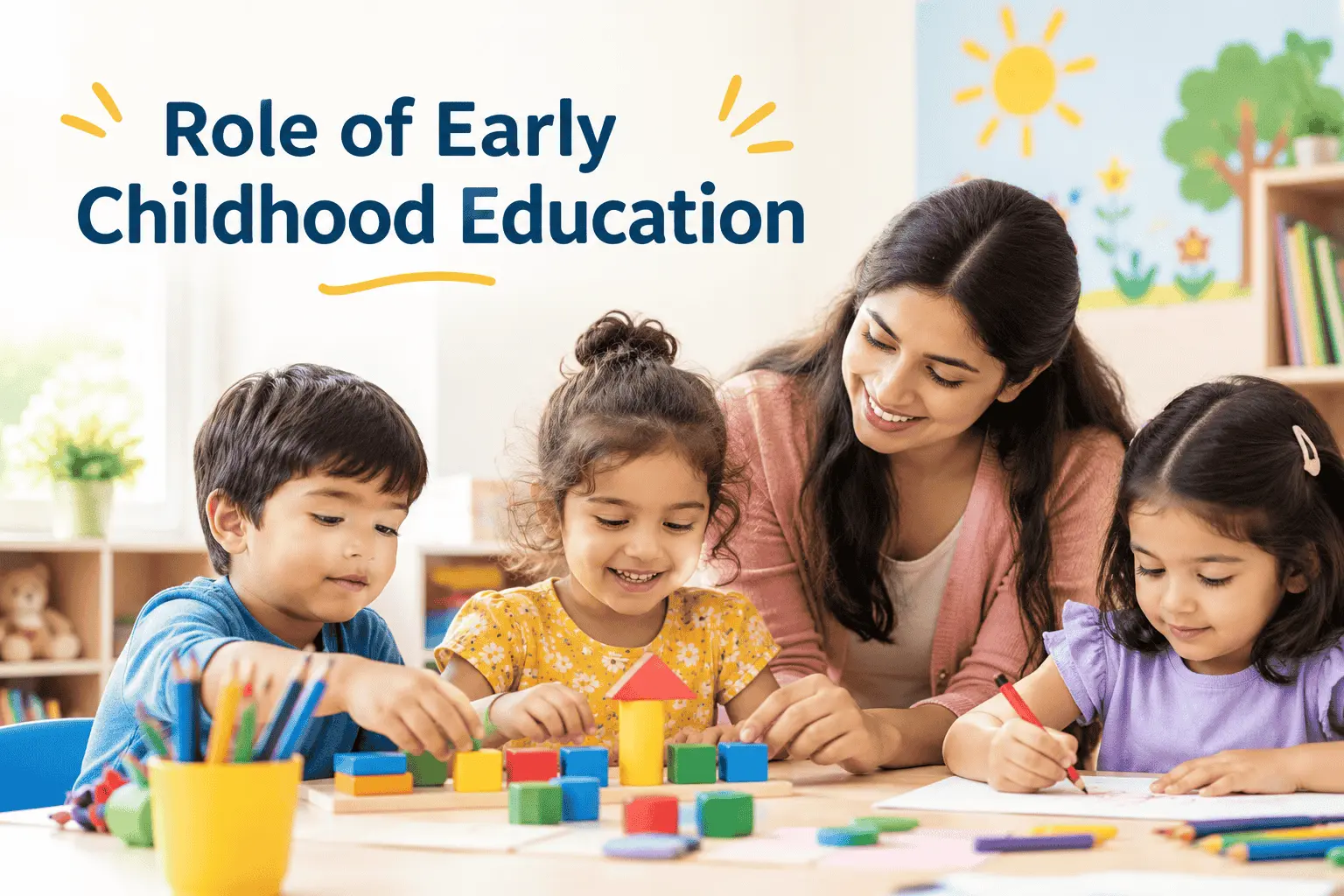
On the first day of preschool, a child may be quiet, unsure and hesitant to join the others. A few weeks of building with blocks, listening to stories, group activities and conversations with teachers can change that. Children start asking questions, sharing ideas and trying new things.
The importance of early childhood education goes well beyond preparing children to read and write. The early years are when the brain develops fastest, and learning happens across cognitive, language, social, emotional and physical areas at once.
In this guide: what early childhood education is, how it supports each area of development, the role of play and school readiness, what a high-quality program looks like, how parents can help at home, and how to choose a preschool.
What is early childhood education?
Early childhood education (ECE) is the learning and care children receive before formal schooling begins, usually from ages 2 to 6. It includes nursery, preschool, kindergarten, Montessori and other early learning programs.
In India, the National Education Policy (NEP) 2020 recognises this stage as the Foundational Stage, covering ages 3 to 8, with early childhood care and education as its base. [Add one line on how your CBSE or Cambridge early years program follows this.]
At this age, children learn best through play, conversation, movement, creative activities, routines and guided learning, not through worksheets alone.
Why early childhood education matters
The first years of life are when children form the habits and skills they build on later. Quality early learning helps children:
- Build confidence in communicating and trying new things
- Develop curiosity and a positive attitude to learning
- Learn to manage emotions and get along with others
- Transition smoothly into Grade 1
How early childhood education supports child development
1. Cognitive development
Children learn by asking questions, observing and experimenting. Puzzles, sorting games, building blocks, storytelling and simple experiments build memory, attention, reasoning and problem-solving. Good teachers ask children to explain their thinking instead of handing over answers.
2. Language and literacy development
Children build language through listening, talking and regular conversations. Stories, rhymes, songs, picture books and role-play introduce new words and help children express ideas. Early literacy skills grow as children recognise sounds, follow stories, identify letters and learn how books work.
3. Social and emotional development
Classroom life gives children daily practice at sharing, taking turns, cooperating and listening to other points of view. With teacher support, they learn to recognise feelings, resolve disagreements and communicate needs.
4. Self-control and emotional regulation
Young children are still learning to handle frustration and wait for a turn. Consistent routines and supportive teachers give them simple strategies for calming down and solving problems, and self-control grows with practice.
5. Physical development
Running, climbing, drawing, cutting, threading and building develop both gross motor skills (balance, coordination) and fine motor skills (the hand control needed for writing later).
6. Self-confidence and independence
Choosing an activity, tidying up, dressing themselves and finishing small tasks all build independence. When teachers treat mistakes as part of learning, children become more willing to try.
The role of play in early learning
Play is how young children learn. Pretend play builds language and empathy, construction play builds spatial and problem-solving skills, and outdoor play builds physical strength and social skills.
In a play-based learning program, teachers plan the activities and the environment with specific learning goals in mind, so play is structured learning, not free time.
What is school readiness?
School readiness is not about memorising the alphabet or numbers before Grade 1. It means a child can:
- Communicate needs and ideas
- Follow simple instructions and routines
- Separate from parents with reasonable comfort
- Work and play with other children
- Show curiosity and hold a pencil with growing control
Children who build these skills early usually find the move to formal schooling easier.
What does a high-quality early childhood education program look like?
- Qualified, supportive teachers who understand child development and adapt to different learning needs
- A developmentally appropriate curriculum that balances language, early maths, creativity, movement and exploration without unnecessary academic pressure
- A small, supportive environment with enough individual attention and space for both group and independent activity
- Meaningful assessment that helps teachers understand each child’s progress instead of testing young children
- Family engagement, with regular communication and consistent expectations between home and school
How parents can support early childhood development at home
- Read together every day and talk about the story
- Ask about their day and listen to the answer
- Involve them in simple chores such as setting the table
- Encourage outdoor play
- Offer age-appropriate choices
- Let them try before you step in, and ask questions like “What do you think will happen?” or “How could we try this differently?”
How to choose the right preschool
| Factor | Question to ask |
|---|---|
| Teaching approach | Does it match how young children learn? |
| Teacher interaction | Are teachers patient and respectful? |
| Environment | Is the space safe, welcoming and suitable for exploration? |
| Curriculum | Does it balance academics with play, creativity and movement? |
| Class size | Will my child get individual attention? |
| Assessment | How is progress tracked and shared with parents? |
| Family involvement | How are parents kept informed? |
| Daily routine | Is there a balance of structured activity, free play, rest and outdoor time? |
Visit the school and watch a classroom in action. Families looking for a preschool in Uppal, Hyderabad can explore the early learning program at Scholars World School, Uppal and book a campus visit. [Add: curriculum, teacher-child ratio, age of entry, and a real classroom example. These details make the page more useful than competitors.]
Building strong foundations
The early years shape how children approach learning, relationships and challenges. The goal is not how much a child can memorise before school but whether they become curious, confident, communicative and increasingly independent. When schools and families work together, children get a stronger start.
Ready to see an early learning classroom? Book a campus visit or learn about admissions at Scholars World School, Uppal.
FAQs
1. How does early childhood education support child development?
It supports cognitive, language, social, emotional, and independence skills through age-appropriate learning, play, and everyday interactions.
2. What are the benefits of early childhood education for children?
It helps children build confidence, communication skills, problem-solving abilities, social skills, and readiness for formal schooling.
3. How does play support early childhood learning?
Play allows children to explore, solve problems, express themselves, interact with others, and learn through hands-on experiences.
4. What skills do children develop through early childhood education?
Children develop communication, early literacy and numeracy, problem-solving, cooperation, self-control, creativity, and independence.
5. What should parents look for in an early childhood education school?
Parents should consider the teachers, curriculum, classroom environment, class size, learning approach, assessment methods, and family involvement.